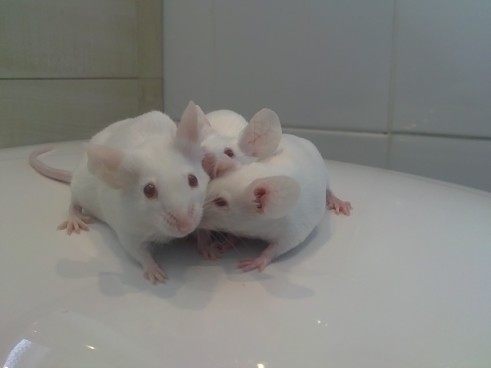
Mouse Care
Life span
Mice can live for 1 - 4 years.
The life span of a mouse varies alot females tend to only live for 1-2 years as they are prone to getting mammary gland tumours though somtimes they can live longer up to 4 years. I had a rescued wildmouse that could not be realesed back into the wild and she lived fr 4 years and didnt get any tumours. Males tend to live longer about 2-3 years but like with the females this is not always the case sometime they only get to 1 years old.
Housing
It is best to house mice in either glass or plastic though bar cages can be used but the gaps between the bars must be very small so that the mouse can not squeeze out, as mice can squeeze through extreamly small gaps. Glass or plastic cages but have good ventalation as poor ventalation can cause respirtary problems.
Flooring and bedding
For flooring i use wood shavings but soft shreaded paper or paper based cat litter can be used instead. News papper should not be used, if eaten the ink can poisonous for the mouse. For bedding it is best to use the soft shreaded material one rather than the wooly bedding and the wooly bedding can become tangled arround their body head and legs. Also soft hay can be used but occasionally you can find parasites in the hay which will transfer on to your mice.
Food and water
Water can be provided in a bowl or a water bottle. Water bottles tend to be better as the water will not get contaminated and will not make the cage wet.
Food - Mice can be fed a rodent mix which must not contain too many sunflower seeds and no peanuts. You can also buy a special complete diet food especially designed for mice. Or you can mix your own using wild bird seed mixed with rabbit or other rodent mix. Also if you breed and want good strong quality mice you can add 1 scoop of lactol puppy replacement milk, 1 spoon full of berpher bone builder to 1 bucket of food aslo you can add small dog or cat biscuits to the mix and boneo puppy milk biscuits broken up.
Illnesses
Tumours - Female mice are mainly prone to these, they tend to get mamary glad tumours. Male mice can get tumours too. Tumours are large growths that can sometimes be slow growing or fast growing depending on how aggressive the cancer is. Often you can see a large growth on the mouse though sometimes if the growth is in there stomach you will see there belly getting bigger and bigger and if felt it will feel hard. Tumors are fatel to mice, they can be surgically removed but it is risky as they are such small animals but it can be sucsessful but will probably only give the mouse an extra 3 months if the tumor is slow growing. Once you can see a tumor it is bound to have spread around the body so if you remove one lump another will appear some where else soon after. Once a tumor has been spotted it could be another few months before you have to take your mouse to be euthanased if it is a slow growning tumor. If it is fast growing then it might be only a few week befor you have to take you mouse. If tumours are left for too long they can get enourmous nearly the same sive as another mouse which is unkind to the mouse as they will struggle to move arround, ocasionally if left to get too big they can burst due to over streching of the skin and the mouse will bleed to death. If your mouse has a tumor you will notice it will be loosing weight as the tumour feeds off the mouse taking all the goodness to help it grow, it also has a large blood supply. If you are going to have your mouse opperated on it is best to do it as soon as possible when the tumor is still small as it is easier to remove and a better chance of it not coming back, also the longer you wait the weeker the mouse becomes meaning less chance of pulling through. I had one of my mice opperated on before to have a tumor removed she suvived her first op and seemed really well and 2 months later she had another tumor that i had removed again she made it through the op but couldnt pull her self out of the anasethic and passed away. Personally i would never have a tumor removed again as it does not give them much longer life its a big op for them to go through and it is fairly expensive.
respiatory problems - Mice are prone to respiary problems, if you notice your mouse breathing heavy, a bit sneezy or making noise when breathing it is best to take your mouse to the vets and it will be given a course of baytril which should cure it but doesnt allways work so other medication may be given.
Itchy skin - can be due to parasites if taken to vet you can get parasite drops like flea drops for cats and this should solve the problem. Sometimes itchy skin can be a sign or skin cancer.
Head tilt - If you mouse is walking arround with its head slightly tilted on the side it has probably got an inner ear infection you will need to take you mouse to the vet for this and it will have to go on some antibiotics. In really serious cases the mouse will constantly loose its balance and walk round in circles. This problem can be hard to cure sometimes especially if the problem has been left for a long time with out treatment.
Parasites - mice can get many parasites which include fleas, mites, lice, worms etc. The best way to treat this is to take your mouse to the vets and get some parasite drops which will kill all parasites internally and externally. I use xeno 50 mini drops for my mice.
If you are unsure what is wrong with your mouse it is best just to take it to the vets to get it checked out.
Swollen leg or small lump - a swollen leg or a small lump can be an abcess, often if mice fight (usually males will fight if kept together) a bite can get infected and form an abcess if this happens it is best to take your mouse to the vets as it will need baytril to clear the infection. Lumps are not allways abcesses sometimes lumps can be tumours which are cancer these cannot be treated.
Warts - Sometimes mice can get warts. Warts are little growths like small lumps, there is no treatment for them, sometimes they can get caught especially when the mouse scrattches this will cause them to bleed but they should dry up and be fine after that normally once a mouse has scrattched its wart it will probabbly keep catching it, everytime the wart is caught they tend to get bigger sometimes they will spread and the mouse will have a few over their body but often they dont usually they will just have one. Very occasionally if a mouse has a wart which it has caught many times so is larger in size, if badly scratched can serverly bleed which can be fatal for the mouse. So it is best to keep a close eye if you mouse has a wart.
Eye problems - Sometimes mice can get eye problems these can be caused by getting something stuck in there eye, the eyes surface gets scratched, the eye gets stuck or the eye drys out. Eye infections require medical treatment such as antibiotic eye ointment which will help if the eye has had something stuck in it, scratched or is ulcerated etc. If the eye is dry or keeps getting stuck shut the mouse will require moisterising eye ointment which will help keep the eye moist. Human eye ointment can be used but it is best to go to the vet and get it checked out to make sure your mouse is treated correctly.
